













Old houses bring enormous amounts of charm to any neighbourhood. When you walk past one, it might put you in a good mood, or bring out the words: ‘I should get a house like that’.
The reality, though, is not always as picturesque as you’d imagine. An older property could look gorgeous from the outside, but once you take a closer peek, you’ll come across lots of challenges that a newer build doesn’t bring.
This doesn’t mean that old houses aren’t worth buying. It just means that you need to be prepared for what’s on the other side.
If you’re thinking about buying an older house to renovate it – or even if you want to leave it exactly as it is – this is the article for you. Here’s your no-nonsense guide to old houses in the UK.
What classifies a house as ‘old’ in the UK?
It’s natural to feel a bit confused about what an ‘old’ house truly is. Each person has their own definition. So, is there a definitive rule?
Strictly speaking, there’s no official definition. But in the UK property world, ‘old’ generally means pre-WW2, and more often pre-1919. That’s the point where housebuilding shifted dramatically due to new regulations, new materials, and mass development.
‘Old’ is also relative to the area. For example, in a new town like Milton Keynes, a house built in the 1960s could feel ancient to locals. Meanwhile, in York or Bath, a house from the 1960s might feel like it was built yesterday.
How to find out the age of a house
If you want to find the age of your property, the most reliable place to start is the title deeds, available through the Land Registry. That often gives the clearest indication.
Just remember that older homes don’t come with an exact ‘built’ date – only the first recorded sale. This means that if it wasn’t sold for hundreds of years, the date it was built might not be reflected.
You can also use architectural features to help you identify the age. Georgian homes are usually symmetrical and brick-built, with sash windows and clean façades. Victorian homes are more decorative, with bay windows and ornate fireplaces. Tudor homes tend to feature timber frames, steep gables and tall chimneys.
The National Archives, local council records, and even local historians can help piece together the timeline. Some people even ask neighbours, which might be more insightful than you’d imagine.
Types of old houses in the UK
One of the joys of buying an old house in the UK is that it’s like choosing which century you want to live in. If it hasn’t experienced a huge amount of renovation, it could still look true to its original form. This is quite an exciting prospect.
Tudor and Tudor Revival
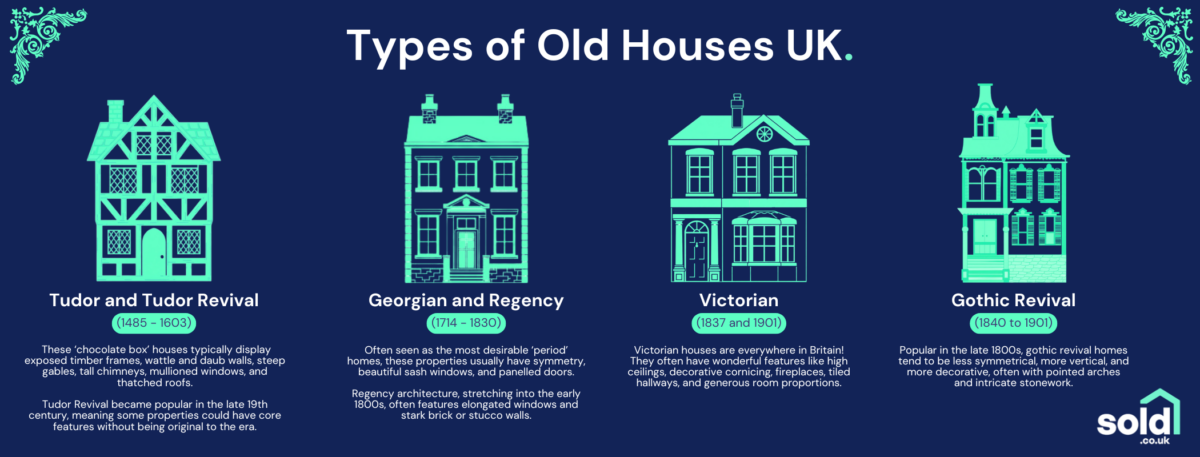
Tudor homes, built roughly between 1485 and 1603, are what people typically describe as ‘chocolate box houses’. You’re likely to see exposed timber frames, wattle and daub walls, steep gables, tall chimneys, mullioned windows, and thatched roofs.
Don’t forget that Tudor Revival became popular in the late 19th century. This means that some properties could have some of the core features, but simply be ‘pretending’.
Georgian and Regency
Georgian houses, built between 1714 and 1830, are often seen as the most desirable period homes in the UK. These properties usually have symmetry, sash windows, and panelled doors, providing a solid construction and practical layouts that still suit modern living better than many other historic styles.
Regency architecture, stretching into the early 1800s, often features elongated windows and stark brick or stucco walls. London townhouses are one of the most common places that you’ll see this.
Victorian
Victorian houses are everywhere in Britain – meaning that you probably recognise what one looks like, even if you don’t know the name. They often have wonderful features like high ceilings, decorative cornicing, fireplaces, tiled hallways, and generous room proportions.
Gothic Revival
Gothic Revival became popular in the late 1800s, pushed by architect Augustus Pugin. He was determined to revive medieval forms and Christian-inspired design. Gothic revival homes tend to be less symmetrical, more vertical, and more decorative. You’ll often find pointed arches and intricate stonework.
Britain’s unique old homes
Old houses aren’t just cottages and townhouses. Britain has some genuinely bizarre historic homes that prove people will live anywhere if it has a roof and a fireplace.
Many historians and architects agree that the oldest home in the United Kingdom is ‘Knap of Howar’, on the Island of Papa Westray in Orkney, Scotland. It was built in 3,700 BC and is a Neolithic farmstead. It’s also considered one of the oldest preserved stone houses in northern Europe.
Another fascinating example of a unique old property is the Kinver Rock Houses in Staffordshire. These are cave dwellings carved directly into sandstone, and they were lived in until the mid-20th century. The earliest documented record goes back to 1617, when a parish register recorded the death of ‘Margaret of the fox earth’.
Scotland also offers a fairytale selection of historic homes rescued by the Landmark Trust. Examples include Saddell Castle in Kintyre, first built in 1508, and Rosslyn Castle in Midlothian, with parts dating back to 1622 and earlier. The latter property has even been updated with renewable energy features.
Likewise, Fairburn Tower, a 16th-century property from the Scottish Renaissance, was refurbished in 2023. It now contains solar-heated en suites, a wood burner and a library. That is the ultimate example of an old home getting new features brought in.
Lots of effort goes into preserving these iconic homes. The National Trust is responsible for much of this work.
How much does an old house cost?
Old houses are expensive when they’re fully renovated and modernised. However, if they need a lot of work you may be able to buy one for a reasonable price. Just make sure you’re aware of all the challenges that come with it.
A derelict Grade II-listed farmhouse sold for £537,000 in 2022. That might sound like a reasonable amount, until you realise it was basically a historical shell requiring a full-scale restoration. The buyers were paying for the history, and Grade II listing.
In Cumbria, a mid-19th century mansion sold for just £460,000 in 2019 after being vandalised and left in disrepair. Again, it was a bargain for the size and status, but only if you ignore the renovation bill involved to bring it back to a reasonable standard.
When an old house is in outstanding condition, it will often go for upwards of £1 million, especially if it has a fascinating history or is listed. And if you’re looking to buy a historic property in London, it’ll be several millions at the very least.
The more unknowns an old property has, the more the price drops. And once you add listed status, planning restrictions, and specialist labour costs, many buyers will run a mile. It’s only a select few who have the patience, money, and time to stick it out.
The hidden costs of owning an old house
Living in an old house might feel romantic, but it can also put a strain on your bank account. Lots of people don’t realise this until it’s too late. So, let’s make sure you’re prepared.
Maintenance is constant with an old house. They don’t tend to ‘settle down’ and behave without enormous investment. For example, lime mortar crumbles, roof timbers age, old drains fail, and solid walls attract damp if ventilation is insufficient.
Second, insurance is often higher for an older property. Many insurance companies see it as a higher risk. A thatched roof, outdated wiring, or unusual construction methods will only magnify their concerns.
Repairs cost more on an old house because the labour is specialised. You can’t just throw any builder at a Georgian townhouse and hope for the best. You need an experienced expert who understands the materials and knows how to fix it without damaging the structural integrity (or history) of the building.
Renovating a listed building: a peak behind the scenes
If your old house is listed, you don’t own it in the way that other people own a house. Listed buildings are protected because they’re considered nationally important – and the rules are incredibly strict.
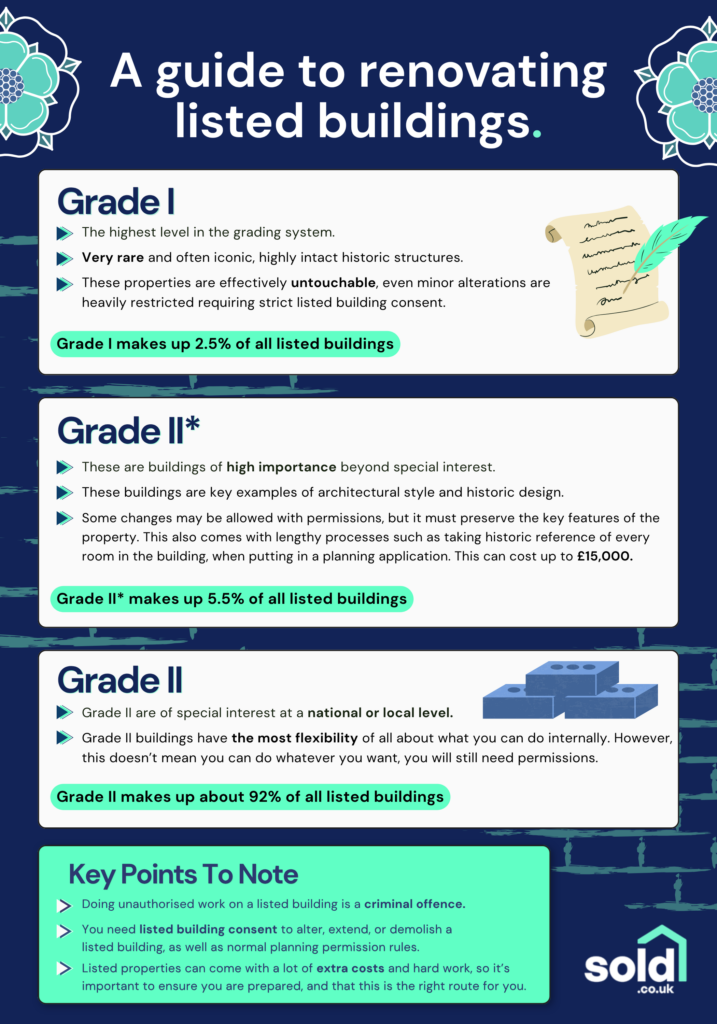
There are roughly 400,000 listed properties in the UK. These are separated into the following grading system:
Grade II makes up about 92% of listed buildings. Grade II* makes up 5.5%. And Grade I makes up 2.5%.
And here’s the key point: doing unauthorised work on a listed building is a criminal offence. You need listed building consent to alter, extend, or demolish a listed building. That sits alongside normal planning permission rules.
Grade I features the most iconic properties in the country. These are effectively untouchable, and you won’t be able to buy them for residential living, anyway. Examples include Buckingham Palace, Westminster Abbey, St Paul’s Cathedral, and the Tower of London.
With a Grade II* building, it’s possible to convert and do works to it. You need to take a historic reference of every room in the building, when putting in a planning application. A potential upside of this, though, is that it will leave you with a lovely book of the history of the house. This can cost up to £15,000.
Grade II buildings have the most flexibility of all about what you can do internally. This doesn’t mean you can do whatever you want, though. You still need permission.
If you want to renovate a listed building, a planning consultant is essential. They help you to navigate quite a complicated system.
Are old houses a worthwhile investment?
Old houses perform brilliantly in the property market when they’re well maintained. You’ll need to put time, effort and money into looking after it. And more importantly, you’ll need a clear paper trail of your permissions for all work, including anything that’s been denied in the past.
Just remember that an old house is not a ‘quick flip’ opportunity. Listed buildings in particular scare off buyers, and for good reason. They cost more to renovate, take longer to sell, and limit what you can change.
Even if you convert a listed building into flats, the service charge often ends up higher, because ongoing maintenance is more frequent than in modern developments.
Some people would do anything for a historic home. That’s why the market still exists for this type of property, especially in England, where lots of people are looking for character in the places they live.
You should also keep your eyes peeled for grant support available when doing restoration work. Timing matters with this, though, as funding tends to be strongest early in the financial year.
So yes, old houses are a strong investment, but only if you treat them like a long-term asset and budget properly. The people who lose money are the ones who buy based on romance, and don’t understand all the hassle and preparation that comes with it.
How to update an old house without ruining it
You should always show reverence to an old house when you purchase it. In other words, don’t go in with the intention of tearing everything to shreds. Even if you get planning permission (which is unlikely) these beautiful homes are unique, and will look best when you retain some of the core features.
The best renovations keep original features like fireplaces, staircases, cornicing, floorboards and sash windows. Many planning authorities are particularly protective of fireplaces and staircases, and removing them is often a hard no.
Modern updates work best when they’re subtle. Examples include hidden storage, modern kitchens designed to suit the period, and traditional-style radiators.
Bathrooms are often the easiest room to modernise because many old houses had bathrooms added later anyway. If a previous owner renovated them in the 1980s, replacing them is rarely controversial because they aren’t original.
The future of old properties: Britain is about to get stricter
How the government views old properties is shifting. While they remain crucial to retaining our history and architecture, there’s also one eye casting over the move to net zero. Unfortunately, much of Britain’s old housing stock is inefficient and expensive to heat.
That means regulations, incentives, and expectations around insulation, renewable heating, and energy performance are only moving in one direction.
Listed buildings will remain protected, but the debate is shifting. In the coming years, buyers will look for old houses that have been upgraded intelligently. Heat pumps, solar panels, secondary glazing and breathable insulation will become selling points, not controversial extras.
The best approach in the ‘old house market’ is to adapt slowly, cautiously, and with a clear paper trail of all the permissions needed.
Is an old house right for you?
Buying an old house is not a decision that you should make lightly. It’s a lifestyle choice, which impacts how you interact with your property daily.
If you want a simple life, with predictable bills and lots of easy repairs, then it’s probably not the right choice for you.
If you’re dying to live in a house with soul, history, and beautiful craftsmanship, then it’s far more likely to suit you. Just make sure that you’re ready for the costs, time, and stress involved.
The smartest buyers go in with eyes open. Check the deeds and research the maintenance involved. Put simply: it can be a privilege, not a burden, if you approach it with the right mindset.