













Selling your house is not a walk in the park. When you get your marketing spot-on, there could be an outstanding deal heading your way. Unfortunately, that’s not the case when you get it disastrously wrong.
So, with properties prices in the UK higher than ever before, it’s never been more important to market your house correctly.
Latest figures show that more than 90% of home buyers begin their search online. This means that the first viewing of your property doesn’t happen when they book a viewing. Instead, it happens on a phone screen while someone is sitting on the sofa scrolling through Rightmove.
That shift alone has changed the game. A decade ago, a simple estate agent listing and a few photographs did the job. Today, sellers face a crowded digital marketplace where hundreds of properties compete for attention every single day.
Understanding the psychology, and theatre, behind property marketing will put you one step ahead of the rest. You’ll watch rival homes sit on the market for months while yours finds a buyer within weeks.
House buyers aren’t logical… so, play to their emotions!
When your potential buyer is making a huge investment, it’s natural to assume they’ll be methodical and logical. The reality? That couldn’t be further from the case.
Square footage, school catchments, and commuting times can fly out the window when your viewer falls in love with your house. Estate agents know this better than anyone.
Psychologists who study property sales often talk about ‘perceived value’, rather than actual value. A house has a measurable market price, but the way it feels when someone walks through the door can dramatically influence how that value is perceived.
That’s why the sensory experience matters so much. A home that smells fresh, feels bright and looks inviting immediately sends a powerful signal. A home that smells of pets, cigarette smoke or damp sends an even stronger one.
Initial impressions stick. Once a buyer forms a negative view, it becomes incredibly difficult to reverse it.
There’s also a deeper emotional layer. Your buyer wants to imagine themselves living there – making breakfast for the children, or hosting summer barbecues in the garden. Marketing that taps into this imagination becomes far more persuasive than a simple list of specifications.
This explains why storytelling has become such a powerful tool in modern property marketing. People aren’t buying bricks and mortar – they’re buying an imagined future.
The rise of home staging
Home staging is on the rise in the United Kingdom. And it’s extremely easy to see why.
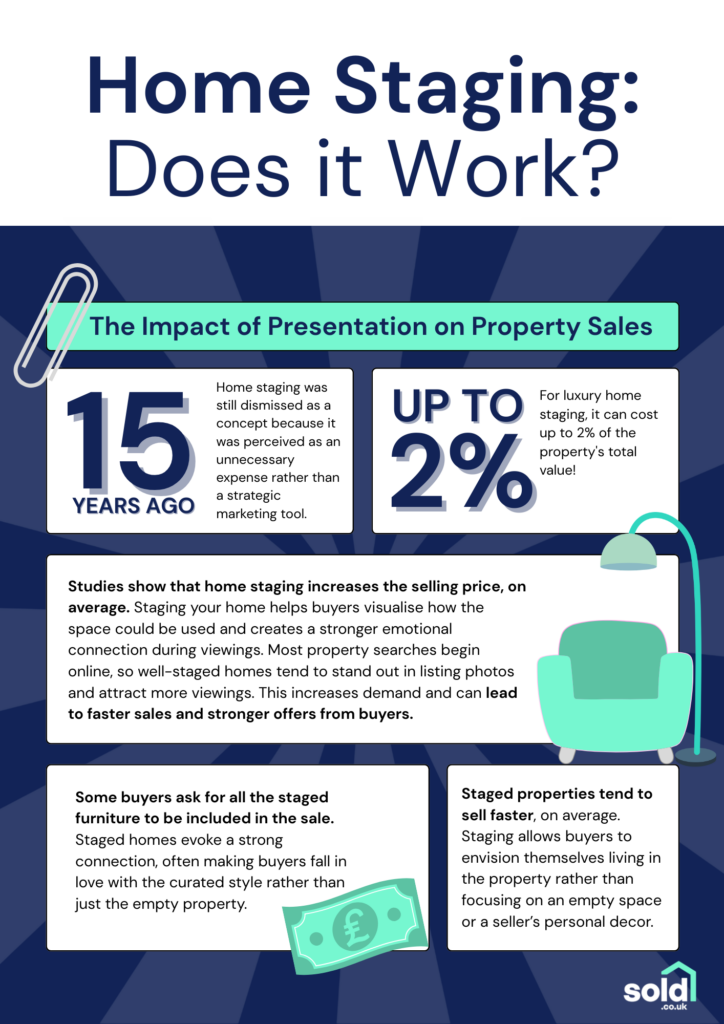
Twenty years ago, staging a house sounded like an American fad. Estate agents have openly admitted that as recently as 2013, and many within the industry dismissed it entirely.
Fast forward to today, and luxury properties frequently undergo full staging before being listed. This sometimes costs between 1% and 2% of the property’s asking price.
That sounds expensive, but there’s plenty of evidence that staged homes often sell faster, and attract stronger offers.
Furniture should be rearranged to highlight the size of rooms. Mirrors are installed to amplify natural light. Meanwhile, neutral colour palettes create calm and small decorative details show your personality.
Fresh flowers introduce colour and scent while soft lighting adds warmth. A carefully arranged sofa facing a fireplace draws attention to one of the home’s most desirable features.
And then there’s the golden rule of staging: depersonalisation.
Family photographs, memorabilia and clutter often disappear before viewings begin. That isn’t about removing your life from the property – it’s just about giving potential buyers space to imagine their own.
Television has also played a surprising role in normalising this approach. Shows such as ‘Selling Sunset’ have raised buyer expectations dramatically. Viewers see perfectly styled homes on screen and arrive at viewings expecting something similar.
You can resent this approach, if you want, but as these strategies become the norm, those with outdated views on house selling are being left behind.
There’s more to selling than Rightmove and Zoopla
There’s no denying that Rightmove and Zoopla are hugely influential platforms. When it’s time to buy a property, almost everyone jumps on there to see what’s around, and plenty of us scroll through the listings in our spare time, for entertainment.
So, it’s undeniable that your listings need to be superb. Outstanding photography, eye-catching descriptions, and the correct pricing band will do wonders.
If you only think about the basics when selling your house, though, then you’re slightly limiting your options. A small amount of effort elsewhere can go a long, long way to standing out.
Increasingly, house sellers are embracing new visual tools. 3D virtual tours and spatial scans allow your potential buyers to explore your house remotely, filtering out casual browsers and only attracting serious interest.
Drone footage has become another popular tactic, particularly for properties with strong surroundings. You can use aerial shots to highlight nearby parks, waterfronts or attractive neighbourhood streets in ways traditional photography cannot. You can pay a local freelancer to do this for a small fee.
Then, if you want to market offline, that’s where the real creativity begins.
Open house events have returned in popularity. Feel free to invite your neighbours first, and make sure to offer refreshments, too.
Direct mail has also experienced a revival amongst some agencies. One British estate agency even produces a quarterly mini-newspaper telling the stories of homes and the people who live in them. Instead of aggressive advertising, the publication takes a softer editorial tone, almost like a lifestyle magazine.
Your buyers will engage with stories far more readily than they engage with sales pitches. Once you throw in unique features, you’ll finally find yourself standing out from the crowd.

The ‘social media selling’ revolution
If one development has truly shaken up the property world, it’s the rise of the ‘social media estate agent’. Social media has been around for a long time – but influencers in the industry? Well, they’re still quite a new concept.
A new generation of agents has built enormous followings on platforms like Instagram and TikTok. They post cinematic property tours, funny commentary and behind-the-scenes glimpses of the housing market.
There are plenty of signs that this approach works.
One well-known social media estate agent, Grant Bates, claims that around 70% of his property sales originate from social media enquiries.
The reach can be astonishing. While traditional property portals often generate a few thousand views for a listing, social media videos can potentially attract hundreds of thousands. The biggest creators will sometimes get millions.
One London property listed for £800,000 gained 1.6 million Instagram views and went under offer within 18 days, with the buyer discovering it through the video alone.
This shift has also changed how estate agents build their careers. Instead of relying solely on large agencies, many agents now build personal brands online. In late 2025, the UK saw 1,624 new estate-agent businesses created – a 48% increase compared with 2017. This was partly driven by agents going independent through social media.
Buyers respond strongly to this personal approach. 43% say they’re more likely to contact agents whose social media content they enjoy, which highlights how personality has become a growing sales asset.
Of course, the trend has critics. Some argue social media property marketing prioritises style over substance. Still, the direction of the industry feels obvious – and it shows no signs of slowing down.
Can Google search trends tell you anything about property marketing?
If you want to understand what buyers are thinking, there’s one place worth looking: Google.
Search behaviour gives a fascinating snapshot of the public’s concerns and priorities. And in the UK property market, those concerns change alongside the economy.
The most searched property-related term is ‘EPC’ (Energy Performance Certificate), with around 290,000 searches every month. You’ll thus be wise to address this in your marketing, such as the description on major platforms. If you can take steps to improve your score, that might help, too.
The second most searched term is ‘mortgage rates’, generating roughly 135,000 searches per month. Searches for ‘shared ownership’ are incredibly high, too, which suggests that first time buyers are looking for creative ways to enter the market.
For sellers, these search patterns offer an important lesson: buyers arrive at property listings already thinking about costs, efficiency and long-term value. Marketing that addresses these concerns will win the day.
Rental and commercial properties: are the marketing rules the same?
Not all property marketing follows the same rules. So, if you’re interested in selling a commercial space or letting out a rental, make sure you’re ready to adapt.
When you’re trying to let out a house, you may consider using a letting agent to handle the marketing process, particularly when managing multiple properties. These agents maintain networks of pre-qualified tenants and help you to avoid costly void periods between renters.
Speed becomes far more important in the rental market. Every week a property sits empty represents lost income. Choosing the estate agent with the best connections can thus be a game-changer.
Commercial property introduces a completely different challenge. In this instance, your marketing must focus on investment potential. Buyers and tenants evaluate footfall, transport links, economic growth and surrounding businesses.
Traditional marketing channels also remain surprisingly important in the commercial world. Research investor exhibitions, printed brochures, or even local radio advertisements – all of these continue to be powerful commercial marketing channels.
Aerial photography carries particular weight in this sector, allowing investors to see the building’s exact location and surrounding infrastructure. Meanwhile, in some cases, you can use detailed CGI visualisations before construction even begins.
The future of property marketing
Looking ahead, the marketing of homes is heading toward a fascinating intersection of technology and storytelling.
Virtual tours already allow buyers to explore homes from across the world. The next step could be immersive viewing experiences using virtual reality headsets. This opens up more doors for international buyers.
Algorithms already analyse search behaviour to recommend homes to potential buyers. In the future, those systems will tailor listings to individual preferences with even more precision than they do today.
But perhaps the biggest change will be expectation.
Buyers are becoming more informed, more visual and more selective. They expect professional photography, compelling descriptions and immersive digital experiences as standard.
A plain listing with a few basic photographs will increasingly feel redundant, and put you on the ‘do not consider’ list.
Marketing isn’t an option – so don’t treat it like one
To get the highest price for your house, you need to embrace the changes in the industry.
With so much money on the line, the small details make a world of difference when you’re trying to stand out.
Be prepared to stick your neck above the parapet, and partner with estate agencies that have a proven track record of results.
After all, there’s a big difference between a marketing campaign built on ‘a hope and a prayer’, versus powerful storytelling that marks you out from the competition. The skill is in knowing the difference.