













Thousands of people sell a house in the UK every year, so it’s natural to assume that the process is straightforward. With something so important, that happens so regularly, it must be easy to do. Right?
Well, if you’ve spoken to anyone who’s sold a house, you’ll know that’s far from the case.
Selling your home is often the biggest financial transaction you’ll ever be involved in. Yet, the process feels old-fashioned and likely to collapse. From deals falling apart to surveys causing delays and solicitors disappearing, there’s a lot that can go wrong.
According to industry figures, more than 300,000 UK house sales fall apart every year. This costs sellers an average of £2,727 each for a sale that never reaches completion. Unfortunately, the system itself is to blame for many of these failed sales.
This article guides you through the process of selling a house in the UK, stage by stage. It explains what actually happens at each point, why it so often goes wrong, and what you need to know before you get started.
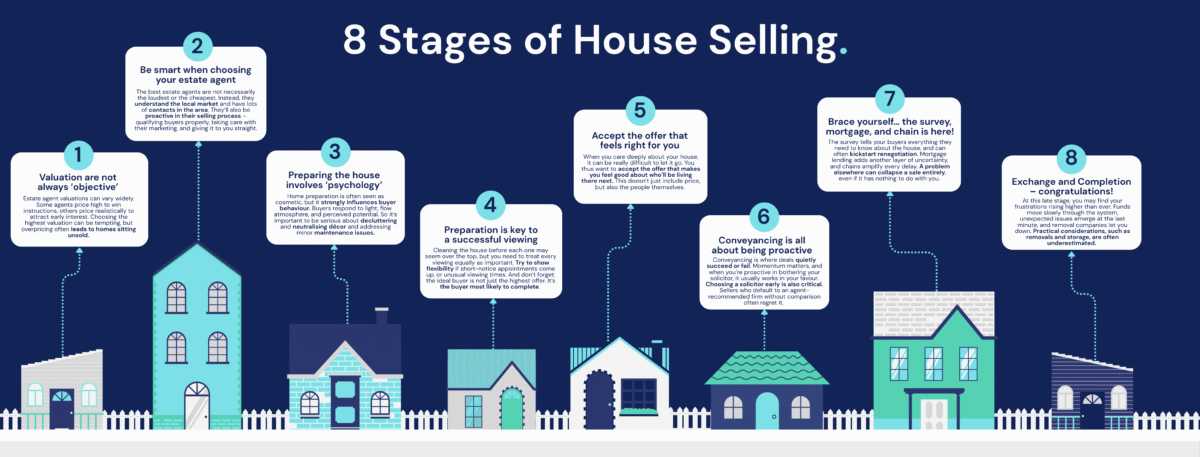
Step One: Valuations are not always objective
The first step of selling your house seems quite straightforward: getting your house valued, so you know what to list it for. Unfortunately, this process isn’t an exact science, and you can encounter a huge variety of opinions in this area.
Estate agent valuations can vary dramatically for the same property. This is not because one agent is right and another is wrong, but because valuation is part market analysis and part sales psychology. Some agents pitch high to win the instruction, confident that reductions can follow later. Others price conservatively to attract early interest and generate momentum.
Sellers are often tempted to choose the highest valuation. This is understandable, but it can backfire. Over-ambitious pricing is one of the most common reasons homes linger unsold. It means that a reduction is often needed further down the line. Buyers tend to view this as weakness, and assume that the house must have issues that make it necessary to drop the price.
The wider market context matters too, as house sales in the UK remain volatile. In January 2025, there were just 46,774 residential transactions across the UK, yet two months later, transactions surged to around 164,650 as people tried to beat the impending stamp duty holiday deadline. These swings demonstrate how season, sentiment and policy distort behaviour, making valuation timing just as important as price.
Step Two: Be smart when choosing your estate agent
Many house sellers take a simple approach to selling their property. A quick Google search, or a walk down the high street, and they’ll opt for the first company they see. This strategy isn’t good enough anymore.
The best estate agents are not necessarily the loudest or the cheapest. Instead, they understand the local market and have lots of contacts in the area. They’ll also be proactive in their selling process – qualifying buyers properly, taking care with their marketing, and giving it to you straight.
You don’t need someone who’s going to tell you what you want to hear. Wishful thinking (and delusion) won’t sell houses. You need someone you trust to tell you the cold, hard reality.
Steer clear of conditional selling, where buyers are steered towards an agent’s preferred mortgage broker or solicitor. You should also be wary of booking fees, opaque referral arrangements and inflated valuations designed to win instructions. If you sense any of these, run like the wind!
Step Three: Preparing the house involves one eye on psychology
Home preparation is often dismissed as cosmetic. In reality, it is behavioural psychology in action. And the best estate agents understand this.
Buyers do not purchase square footage alone. They buy light, flow, atmosphere and perceived potential. You need to be serious about decluttering, neutralising your décor, improving energy efficiency and addressing minor maintenance issues. All of this influences how a property feels, not just how it looks.
Staging techniques can make smaller spaces feel larger and darker rooms feel warmer. Sellers are often surprised by how small changes produce impressive results.
You may also find this stage quite emotional. You’ll need to detach yourself from the house and be open-minded to feedback.
Step Four: Preparation is key to a successful viewing
When your estate agent markets your house well, it’ll bring potential buyers through the door. This is an exciting moment, but there’s also quite a lot riding on it.
Preparation is crucial for a successful viewing. Cleaning the house before each one may seem over the top, but you need to treat every viewing like it’s the most important one you’ll ever do. Who knows, your new buyer could be about to walk through the door.
Try to show flexibility if short-notice appointments come up, or viewers request unusual appointment times. For those with busy work schedules, irregular requests don’t always mean that the viewer isn’t serious about your property.
Feedback is invaluable, even though it may feel uncomfortable. Patterns matter more than individual opinions. If several viewers comment on price, layout or condition, the market is communicating clearly. You’d be wise to listen.
And don’t forget: the ideal buyer is not just the highest offer. It’s the buyer most likely to complete. Chain-free buyers, cash buyers or those with mortgage agreements in principle reduce risk. When you focus exclusively on price, you sometimes learn too late that certainty has its own value.
Step Five: Accept the offer that feels right for you
When you care deeply about your house, it can be difficult to let it go. You want to accept the offer that makes you feel good about who’ll be living there next. This doesn’t just include price, but also the people themselves.
For instance, if you’ve raised your children in the house, then selling to young parents can feel hugely rewarding – because you’re continuing the cycle! Likewise, if you’ve met the buyers and got on well with them, then this tends to make you feel much better, too.
Unfortunately, this stage of the house-selling process is undoubtedly the most out-of-date. Gazumping and gazundering remain legal in England and Wales, which can put all parties in a difficult position. There’s also not much commitment needed for a buyer to make an offer – they don’t have to make an initial deposit, and there’s no penalty if they back out. This lack of commitment is a major reason why so many sales collapses.
You could use reservation agreements or sale-fall-through insurance to mitigate risk. These mechanisms aim to introduce accountability into a system that otherwise relies heavily on goodwill.
Step Six: Conveyancing is all about being proactive
Conveyancing is where deals quietly succeed or fail. Momentum matters, and when you’re proactive in bothering your solicitor, it usually works in your favour.
The longer a sale drifts after offer acceptance, the greater the chance that circumstances change. Mortgage rates shift, surveys reveal issues, chains wobble, or buyers simply rethink.
Choosing a solicitor early is critical. Sellers who default to an agent-recommended firm without comparison often regret it. You should look at reviews and compare speed, communication and experience. Small fee differences are practically meaningless compared to the level of service offered.
Documentation frequently causes delays, and there may be hiccups you hadn’t prepared for.
Step Seven: Brace yourself… the survey, mortgage, and chain are here!
It might feel like the completion of your sale is on the horizon, but not before you clear one more crucial stage, which probably feels like three rolled into one: the house survey, the mortgage lending, and the chaos of selling in a chain.
The survey tells your buyers everything they need to know about the house, but it can often throw a spanner in the works, which kickstarts renegotiation.
Mortgage lending adds another layer of uncertainty. Interest rates have fluctuated significantly in recent years, affecting affordability and buyer confidence. First-time buyers increasingly rely on high loan-to-value products or joint purchasing strategies to access the market, and these both increase risk.
Chains amplify every delay. A problem elsewhere can collapse a sale entirely, even if it has nothing to do with you. This feels especially frustrating.
Step Eight: Exchange and completion – congratulations!
Exchange of contracts is the point of no return. After the previous seven steps, it probably feels like a long time coming – and it usually means that you’re only a few weeks away from moving out.
Completion is when the money changes hands, and you hand over the key. This is often a couple of weeks after exchange, although it could be much sooner.
At this late stage, you may find your frustrations rising higher than ever. Funds move slowly through the system, unexpected issues emerge at the last minute, and removal companies let you down.
You must also account for mortgage redemption, including early repayment charges, which can run into thousands of pounds.
Practical considerations, such as removals and storage, are often underestimated. Professional movers add cost but reduce stress. Friends and family save money but can introduce friction, inefficiency and risk of damage.
Is the selling process the same when your property is unusual?
Not all homes fit neatly into the standard selling process. Unique properties attract attention, but can also involve a slightly more complicated selling process.
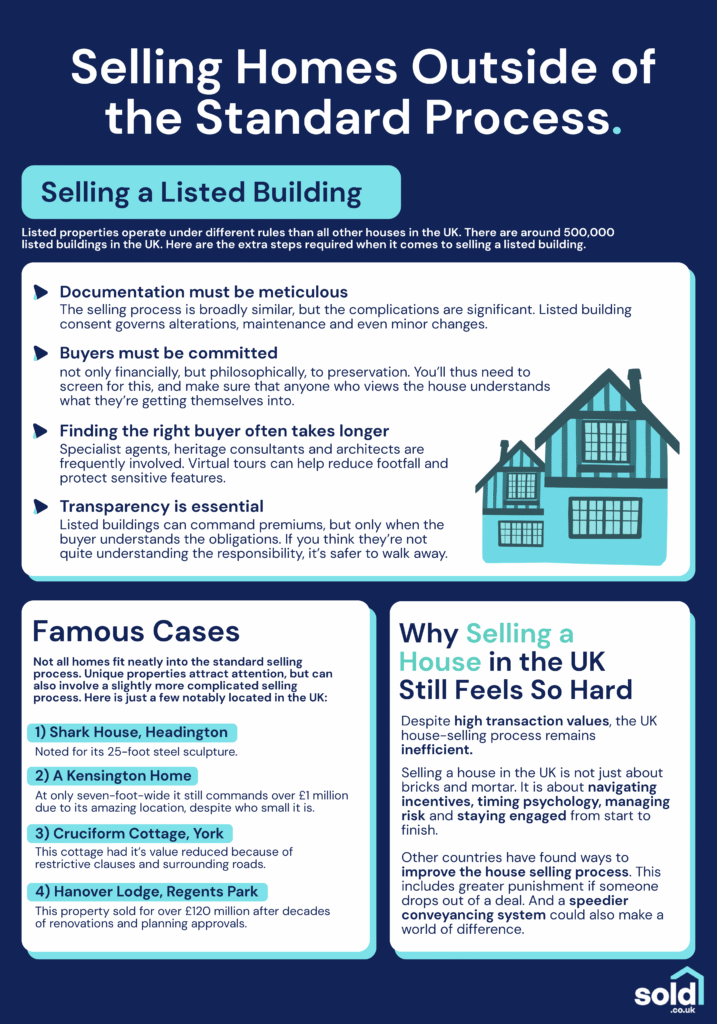
The UK has no shortage of unusual homes. From the Shark House in Headington, with its 25-foot steel sculpture, to island forts accessible only by boat, uniqueness can either command a premium or narrow the buyer pool dramatically.
Some properties become famous, while others are seen as problematic. A seven-foot-wide house in Kensington still commands over £1 million due to its amazing location, despite its tiny size. Meanwhile, a cruciform cottage in York had its value reduced because of restrictive clauses and surrounding roads.
Extraordinary sales also remind us how elastic the market can be. Hanover Lodge in Regent’s Park sold for over £120 million after decades of renovations and planning approvals, while The Holme achieved £139 million despite being listed years earlier for nearly double that price.
Unique situations create an unusual selling process. You may want to get a specialist house seller in these types of properties, or prepare yourself for a lengthier negotiation and a higher likelihood of the deal collapsing. In this case, steps to reduce problems – such as finding a chain-free buyer – can make a bigger difference than usual.
Selling a listed building adds another layer of complexity
Listed properties operate under different rules from other houses in the UK. There are around 500,000 listed buildings in the UK, with Grade II making up the vast majority.
The selling process is broadly similar, but the complications are significant. Listed building consent governs alterations, maintenance and even minor changes. Documentation must be meticulous.
Buyers must be committed not only financially, but philosophically, to preservation. You’ll need to screen for this approach and make sure that anyone who views the house understands what they’re getting themselves into.
Finding the right buyer often takes longer. Specialist agents, heritage consultants and architects are frequently involved. Virtual tours can help reduce footfall and protect sensitive features.
Listed buildings can command a premium, but only when the buyer understands the obligations. Transparency is essential, and if you don’t think they quite understand the responsibility, it’s safer to walk away.
Why selling a house in the UK still feels so hard
Despite high transaction values, the UK house-selling process remains inefficient. It is slow, opaque and emotionally draining. Technology has improved visibility, but not commitment. Legal reform has been incremental rather than transformative.
The truth is, there’s still huge room for improvement in the house-selling process. Those who assume the process will manage itself are often disappointed. It doesn’t – and you need to be proactive to get the deal over the line.
Other countries have found ways to improve the process. This includes greater punishment if someone drops out of a deal. A speedier conveyancing system could also make a world of difference.
Selling a house in the UK is not just about bricks and mortar. It is about navigating incentives, timing psychology, managing risk and staying engaged from start to finish.
For many, the lesson comes too late. For others, preparation makes all the difference. Make sure you fall into the latter category.